
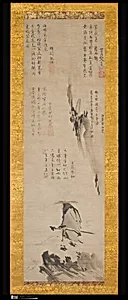
瑞巖龍惺・竹香全悟・九淵龍賝・南江宗沅・ 翺之慧鳳賛 東坡笠屐図|Su Shi (Dongpo) in a Bamboo Hat and Clogs
Medium
Hanging scroll; ink on paper
Dimensions
Image: 42 3/4 x 13 1/8 in. (108.6 x 33.3 cm) Overall with mounting: 74 1/2 x 17 5/8 in. (189.2 x 44.8 cm) Overall with rollers: 74 1/2 x 17 5/8 x 19 3/4 in. (189.2 x 44.8 x 50.2 cm)
Classification
Paintings
Culture & Period
Japan · Muromachi period (1392–1573)
Department
Asian Art
Museum
Metropolitan Museum of Art, New York, NY
Credit
The Harry G. C. Packard Collection of Asian Art, Gift of Harry G. C. Packard, and Purchase, Fletcher, Rogers, Harris Brisbane Dick, and Louis V. Bell Funds, Joseph Pulitzer Bequest, and The Annenberg Fund Inc. Gift, 1975
Accession Number
1975.268.39
Rights
Public Domain
Tags
Art Historical Context
This hanging scroll from Japan’s Muromachi period (1392–1573) depicts the renowned Chinese poet and statesman Su Shi (also known as Dongpo) wearing a bamboo hat and wooden clogs, a motif that evokes his humble travels during exile. Created before 1460 in ink on paper, the work reflects the deep cultural exchange between China and Japan, as Zen monks frequently portrayed Su Shi to embody ideals of resilience, literary brilliance, and harmony with nature. The painting is accompanied by inscriptions from five Zen priests—Kyūen Ryūchin, Kōshi Ehō, Nankō Sōgen, Zuigan Ryūsei, and Chikkō Zengo—highlighting the collaborative nature of Muromachi ink painting. During this era, Zen monasteries served as centers of learning where monks practiced Chinese-style literati themes to convey spiritual insight. The restrained monochrome technique, with its fluid brushwork and emphasis on negative space, invites quiet contemplation, aligning with Zen aesthetics that value simplicity and the suggestion of inner essence over detailed realism. As a hanging scroll, the format allowed the work to be displayed seasonally in temples or tea rooms, fostering moments of reflection for viewers. Today, it stands as a testament to how Japanese artists adapted Chinese subjects to express their own cultural and spiritual values.
About the Artist
Kyūen Ryūchin|Kōshi Ehō|Nankō Sōgen|Zuigan Ryūsei|Chikkō Zengo (Japanese|Japanese|Japanese|Japanese|Japanese) · |1414 |1378 |1384 | –1498 |1465 |1463 |1460 |1464
Japanese, died 1498|Japanese, 1414–ca.1465|Japanese, 1378–1463|Japanese, 1384–1460|Japanese, died after 1464