
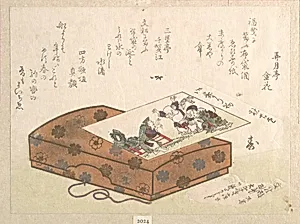
Surimono and a Box
Medium
Woodblock print (surimono); ink and color on paper
Dimensions
5 9/16 x 7 7/16 in. (14.1 x 18.9 cm)
Classification
Prints
Culture & Period
Japan · Edo period (1615–1868)
Department
Asian Art
Museum
Metropolitan Museum of Art, New York, NY
Credit
H. O. Havemeyer Collection, Bequest of Mrs. H. O. Havemeyer, 1929
Accession Number
JP2024
Rights
Public Domain
Tags
Art Historical Context
Behold *Surimono and a* (1808), a delicate woodblock print by Ryūryūkyo Shinsai, a master of Japan's Edo period (1615–1868). This intimate work, measuring just 5 9/16 x 7 7/16 inches, captures human figures in ink and color on paper, of the prestigious H. O. Havemeyer Collection at the Metropolitan of Art. Surimono, meaning "printed things," were luxurious, privately commissioned prints often exchanged among poetry enthusiasts during New Year's celebrations. Shinsai, a leading ukiyo-e artist of the "floating world" tradition, excelled in these small-scale gems, employing refined techniques like subtle gradations of color (bokashi) and metallic pigments for a shimmering effect. The title intriguingly suggests a playful depiction of a surimono housed in an ornate box, blurring the line between art and its presentation. In Edo Japan's vibrant urban culture, such prints celebrated refined tastes and literati circles, far removed from mass-produced ukiyo-e. This piece exemplifies Shinsai's poetic elegance, inviting viewers to appreciate the artistry in everyday luxury.
About the Artist
Ryūryūkyo Shinsai · 1799–1823
Ryūryūkyo Shinsai (柳々居辰斎), active from 1799 to 1823, was a prominent Japanese ukiyo-e printmaker based in Edo (modern Tokyo), renowned for his mastery of surimono—luxurious, privately commissioned woodblock prints produced for elite poetry circles and New Year's celebrations. He began his training under Tawaraya Sōri before becoming a student of the legendary Katsushika Hokusai, from whom he recei...