
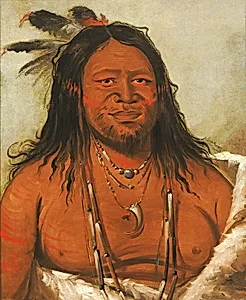
Ta-wáh-que-nah, Mountain of Rocks, Second Chief of the Tribe
1834
Medium
Painting
Classification
Painting
Department
Smithsonian Collection
Museum
Smithsonian American Art Museum
Credit
Smithsonian American Art Museum, Gift of Mrs. Joseph Harrison, Jr.
Accession Number
1985.66.47
Rights
Public Domain
Tags
About this artwork
In 1834, George Catlin accompanied a regiment of United States Dragoons to visit the territory of the Comanche, Kiowa, and Wichita. Catlin later remembered being received by Comanche chief Mountain of Rocks “with great kindness at his village.” He described the chief as “the largest and fattest Indian I ever saw . . . A perfect personation of Jack Falstaff, in size and in figure, with an African face, and a beard on his chin of two or three inches in length. His name . . . he got from having con...
Art Historical Context
In 1834, pioneering artist George Catlin ventured into the vast territories of the Comanche, Kiowa, and Wichita alongside a U.S. Dragoons regiment, capturing portraits that preserve a vanishing world of Native American life. *Ta-wá Wah-que-nah, Mountain of Rocks, Second Chief of the Tribe* depicts the Comanche leader who welcomed Catlin with remarkable hospitality at his village. Catlin marveled at the chief's imposing stature—the "largest and fattest Indian" he'd encountered—likening him to Shakespeare's jovial Falstaff, complete with an "African face" and a striking three-inch beard. Catlin's vivid account reveals the chief's legendary origin: his name stemmed from heroically guiding a Comanche party through a secret underground passage in a granite mountain, evading a powerful enemy and saving their lives. Painted on-site in the Comanche village, this oil portrait exemplifies Catlin's mission to document indigenous cultures amid rapid U.S. expansion, forming part of his renowned *Indian Gallery*. As a cornerstone of the Smithsonian American Art Museum's collection, the work highlights Catlin's realistic style and ethnographic eye, offering visitors a poignant glimpse into Comanche resilience and leadership in the early 19th century.
About the Artist
George Catlin · 1796–1872
George Catlin (1796–1872), born in Wilkes-Barre, Pennsylvania, to Putnam Catlin and Polly Sutton—who had been captured by Native Americans during the 1778 Battle of Wyoming—initially pursued a legal career. Trained at Litchfield Law School, he was admitted to the bar in 1819 but abandoned law after two years to study art in Philadelphia in 1823. Self-taught as a portraitist, Catlin quickly gained ...