
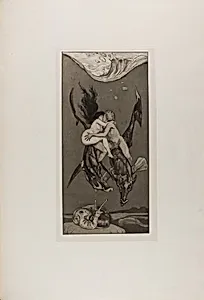
Temptation, plate four from A Life
1884
Medium
Aquatint and etching, with roulette on ivory China paper, laid down on cream laid paper
Dimensions
Image: 47.3 × 22.5 cm (18 5/8 × 8 7/8 in.); Plate: 51.4 × 27.2 cm (20 1/4 × 10 3/4 in.); Primary support: 50.2 × 26.3 cm (19 13/16 × 10 3/8 in.); Secondary support, approx: 78.8 × 57.5 cm (31 1/16 × 22 11/16 in.)
Classification
aquatint
Department
Prints and Drawings
Museum
Art Institute of Chicago
Accession Number
155428
Rights
Public Domain
Art Historical Context
**Temptation, Plate Four from *A Life*** Max Klinger, a pioneering German Symbolist artist, created this evocative print in 1884 as part of ambitious series *A Life* (*Ein Leben*), a cycle of ten etched plates tracing the emotional and psychological journey of a woman through life's stages. Produced during the late 19th century amid the rise of Symbolism and Jugendstil, Klinger's work blends fantasy, eroticism, and introspection, challenging traditional narrative art with dreamlike visions that explore human desires and mortality. This plate, *Temptation*, captures a pivotal moment of seduction and inner conflict, rendered in intricate aquatint and etching techniques augmented by roulette—a toothed wheel that adds velvety textures and tonal depth. Printed on luxurious ivory China paper and laid down on cream laid paper, the medium allowed Klinger to achieve painterly effects rare in printmaking, rivaling oil paintings in richness. The image measures 47.3 × 22.5 cm, with generous margins emphasizing its graphic precision. Housed in the Art Institute of Chicago's Prints and Drawings department, this work exemplifies Klinger's innovation in pushing print techniques toward expressive modernism, influencing later artists like Edvard Munch. Visitors will appreciate its haunting beauty, inviting reflection on the temptations that shape our lives.
About the Artist
Max Klinger · 1857–1920
Max Klinger, born on February 18, 1857, in Leipzig to a wealthy family, emerged as one of Germany's most innovative artists across painting, sculpture, printmaking, and graphics. Demonstrating early talent, he enrolled at the Academy of Fine Arts in Karlsruhe in 1874 as a pupil of Karl Gussow, following his teacher to the Berlin Academy upon Gussow's appointment as director, and graduated in 1877 ...