
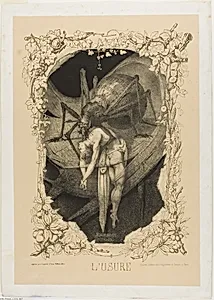
Usury
1851
Medium
Zincograph in black on tan wove paper, laid down on ivory wove paper
Dimensions
Image: 44.6 × 30.7 cm (17 9/16 × 12 1/8 in.); Sheet: 48.9 × 34.7 cm (19 5/16 × 13 11/16 in.)
Classification
zincograph
Department
Prints and Drawings
Museum
Art Institute of Chicago
Accession Number
158956
Rights
Public Domain
Art Historical Context
Charles Rambert’s 1851 zincograph *Usury* offers a striking example of mid-nineteenth-century printmaking at a moment when artists sought to reach broader audiences through affordable reproductive techniques. Created on zinc rather than the more traditional stone used in lithography, the work exemplifies zincography’s advantages: it allowed for sharper lines and greater durability on the press, making it ideal for circulating images that commented on contemporary social issues. The title itself points to a long-standing moral and economic debate. Usury—the lending of money at excessive interest—had been condemned for centuries, yet it gained fresh urgency during the industrial expansion of the 1840s and 1850s, when rapid urbanization and new banking practices reshaped daily life. Rendered in black on tan wove paper and mounted on a second sheet for stability, the print’s modest scale and tonal contrast invite close looking, suggesting Rambert intended the image for thoughtful contemplation rather than grand display. Today housed in the Art Institute of Chicago’s Department of Prints and Drawings, *Usury* reminds viewers how graphic media once served as a vital vehicle for social reflection, bridging fine art and public discourse in an era of profound economic change.