
Textile Fragment
Unknown Artist
3rd–4th century
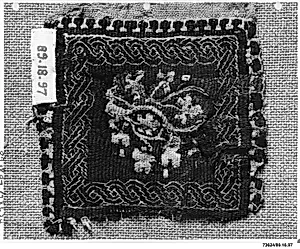
Medium
Wool, linen; plain weave, tapestry weave
Dimensions
Max. H. 2 15/16 in. (7.5 cm) Max. W. 2 3/4 in. (7 cm)
Classification
Textiles
Department
Islamic Art
Museum
Metropolitan Museum of Art, New York, NY
Credit
Purchase by subscription, 1889
Accession Number
89.18.97
Rights
Public Domain
Art Historical Context
This delicate Textile Fragment, dating to the 3rd–4th century, offers a glimpse into the sophisticated textile traditions of the early Islamic world—or its cultural precursors in regions like Egypt or the Near East. Acquired by the Metropolitan Museum of Art through a subscription purchase in 188, this tiny piece (just under 3 inches in both height and width) survives as a testament to ancient craftsmanship preserved in arid environments. Crafted from wool and linen using plain weave for the foundation and tapestry weave for decorative elements, it exemplifies techniques that allowed for vibrant, pictorial designs on clothing, furnishings, or mummy wrappings. Tapestry weave, where wefts create discontinuous patterns without floating threads, was prized for its durability and visual impact, bridging late antique and emerging Islamic aesthetics. Housed in the Met's Islamic Art department, this fragment highlights the continuity of textile arts across empires—from Roman-Byzantine to early Islamic eras—where motifs often blended local, Persian, and Mediterranean influences. Though its exact design is worn, it invites us to imagine the daily lives and trade networks that wove these stories into fabric.