
Textile Fragment
Unknown Artist
5th–6th century
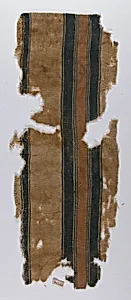
Medium
Wool (?); plain weave
Dimensions
Max. H. 18 1/2 in. (47 cm) Max. W. 6 11/16 in. (17 cm)
Classification
Textiles
Department
Islamic Art
Museum
Metropolitan Museum of Art, New York, NY
Credit
Gift of George F. Baker, 1890
Accession Number
90.5.165
Rights
Public Domain
Art Historical Context
This delicate textile fragment, dating to the 5th–6th centuries and now in the Metropolitan Museum of Art Department of Islamic Art, transports us to the vibrant world of Late Antique weaving in the Near East or Central Asia—regions pivotal to the emerging Islamic cultural sphere. Crafted from wool (or a wool blend) in a plain weave, it measures a modest 18½ by 6⅞ inches, likely a survivor from a larger garment, curtain, or furnishing. The plain weave technique—threads interlaced at right angles in an over-under pattern—represents one of humanity's oldest and most practical methods, prized for its strength and versatility. Such fragments are rare treasures, offering invaluable insights into pre-Islamic textile traditions that influenced later Islamic arts, including intricate pattern weaving and natural dyeing. Wool's use underscores its role in everyday life across arid landscapes, traded along Silk Road precursors. Generously gifted to the Museum in 1890 by George F. Baker, this piece highlights early 20th-century passion for Islamic artifacts, reminding us how fragile fabrics bridge ancient craftspeople to modern admirers.