
Textile Fragment
Unknown Artist
4th–5th century
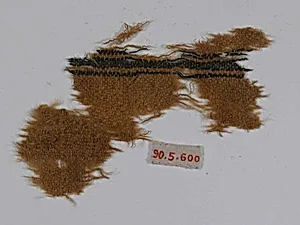
Medium
Wool; plain weave
Dimensions
Max. H. 3 15/16 in. (10 cm) Max. W. 2 3/8 in. (6.1 cm)
Classification
Textiles
Department
Islamic Art
Museum
Metropolitan Museum of Art, New York, NY
Credit
Gift of George F. Baker, 1890
Accession Number
90.5.600
Rights
Public Domain
Art Historical Context
This delicate textile fragment, dating to the 4th–5th century, a glimpse into the everyday artistry of the ancient Near East. Crafted from wool using a plain weave—a straightforward yet durable technique where warp and weft threads interlace at right angles—it measures just under 4 inches high and 2.5 inches wide. fragments, often surviving from garments, furnishings, or ceremonial items, highlight the practical ingenuity of early textile production in regions that would later flourish under Islamic culture. Housed in the Metropolitan Museum of Art's Islamic Art Department, this piece underscores the continuity of weaving traditions across centuries. Plain weave was foundational for creating robust fabrics suited to nomadic and settled lifestyles alike, allowing for intricate patterns or dyes when desired, though this modest survivor speaks to simplicity and resilience. Its small scale reminds us how even tiny remnants preserve vast histories. A generous gift from George F. Baker in 1890, the fragment invites us to ponder the hands that wove it—anonymous artisans whose work bridged late antiquity and the dawn of new eras. Pause here and imagine its vibrant life long ago.