
Textile Fragment
Unknown Artist
5th century
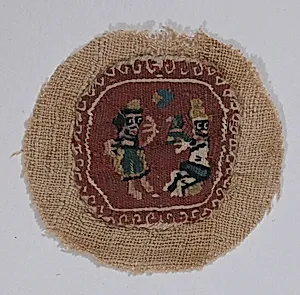
Medium
Wool, linen; plain weave, tapestry weave
Dimensions
Max. H. 4 3/16 in. (10.7 cm) Max. W. 3 3/4 in. (9.5 cm)
Classification
Textiles
Department
Islamic Art
Museum
Metropolitan Museum of Art, New York, NY
Credit
Gift of George F. Baker, 1890
Accession Number
90.5.422
Rights
Public Domain
Art Historical Context
This delicate Textile Fragment, dating to the 5th century, offers a glimpse into the sophisticated textile traditions of the early Islamic world. Crafted from wool and linen using plain weave for the foundation and tapestry weave for decorative elements, it measures just 4 3/16 by 3 3/4 inches—likely a surviving piece from a larger garment, furnishing, or ritual object. Housed in the Metropolitan Museum of Art's Islamic Department, it was generously gifted by George F. Baker in 1890. The use of tapestry weave, where colored weft threads are woven over the warp to create patterns without floating threads, highlights advanced technical skill. This method, prized for its durability and vibrant designs, was widespread in Late Antique and early Islamic regions, such as Egypt or the Near East, where textiles served practical and symbolic roles in daily life, trade, and status display. Though small, this fragment underscores the cultural importance of textiles in pre-Islamic and emerging Islamic societies. They were not mere utilities but canvases for storytelling through motifs, reflecting interconnected trade routes along the Silk Road and Mediterranean. Visitors, imagine the hands that wove it centuries ago—its survival speaks to enduring artistry.