
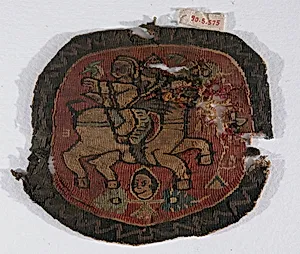
Textile Fragment
Unknown Artist
6th–7th century
Medium
Wool, linen; tapestry weave
Dimensions
Max. H. 4 15/16 in. (12.5 cm) Max. W. 4 1/2 in. (11.5 cm)
Classification
Textiles
Department
Islamic Art
Museum
Metropolitan Museum of Art, New York, NY
Credit
Gift of George F. Baker, 1890
Accession Number
90.5.575
Rights
Public Domain
Art Historical Context
This delicate textile fragment, dating to the 6th–7th century, invites us into the world of early Islamic artistry from the Metropolitan Museum of Art's Islamic Art collection. Crafted wool and linen in a weave—a technique where colorful weft threads are woven discontinuously to form motifs without underlying floats—it measures just 4 15/16 by 4 1/2 inches. Such small survivals hint at larger garments, hangings, or furnishings that adorned daily life in the nascent Islamic world, bridging late antiquity and the dawn of Islam. Tapestry weave was prized for its durability and ability to create intricate patterns, often with geometric or figural designs symbolic of cultural and spiritual values. Though the exact motifs here are not detailed, this fragment exemplifies the technical sophistication of textile production in regions like Egypt or the Near East, where wool provided warmth and linen breathability. Textiles were not mere utilities but status symbols, traded along Silk Road routes. A generous gift from George F. Baker in 1890, this piece preserves a fleeting glimpse of ancient craftsmanship, reminding us how fragile artifacts illuminate vibrant histories.