
Textile Fragment
Unknown Artist
4th–5th century
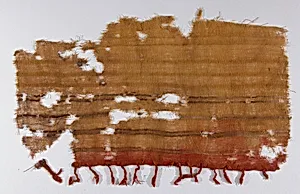
Medium
Wool, linen; plain weave
Dimensions
Max. H. 16 1/4 in. (41.3 cm) Max. W. 7 5/16 in. (18.5 cm)
Classification
Textiles
Department
Islamic Art
Museum
Metropolitan Museum of Art, New York, NY
Credit
Gift of George F. Baker, 1890
Accession Number
90.5.435
Rights
Public Domain
Art Historical Context
This delicate textile fragment, dating to the 4th–5th century, offers a rare glimpse into the daily artistry of late antiquity. Crafted from wool and linen in a plain weave—a fundamental technique where warp and weft threads interlace in a simple one-over-one pattern—it measures just 16¼ inches high by 7⅜ inches wide. Such fragments, preserved through the sands of time, were likely parts of garments, furnishings, or ceremonial cloths in the ancient Near East or Egypt, regions central to early textile production. Housed in the Metropolitan Museum of Art's Department of Islamic Art and gifted by George F. Baker in 1890, this piece bridges pre-Islamic and early Islamic worlds. Textiles from this era highlight advanced weaving skills amid thriving trade routes, blending practical durability with subtle elegance. Wool provided warmth and resilience, while linen added breathability, reflecting the weavers' mastery of natural fibers suited to diverse climates. Though its full design is lost to time, the fragment's survival underscores the cultural importance of textiles as everyday luxuries and status symbols. Visitors can appreciate how these humble threads wove the fabric of ancient societies, influencing centuries of ornamental traditions.