
Textile Fragment
Unknown Artist
4th–5th century
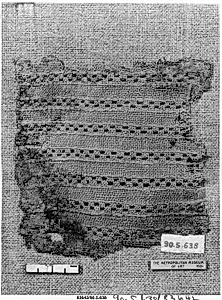
Medium
Wool, linen; plain weave
Dimensions
Max. H. 3 3/4 in. (9.5 cm) Max. W. 3 9/16 in. (9 cm)
Classification
Textiles
Department
Islamic Art
Museum
Metropolitan Museum of Art, New York, NY
Credit
Gift of George F. Baker, 1890
Accession Number
90.5.638
Rights
Public Domain
Art Historical Context
This delicate textile fragment, dating to 4th–5th century, offers a rare glimpse into the everyday artistry of Late Antique weaving traditions. Crafted from wool and linen in plain weave—a simple yet durable tabby where warp and weft threads interlace alternately—this small piece (just under 4 inches square) likely survived as a remnant of larger garments, furnishings, or ritual objects. Such fragments are precious artifacts, as organic textiles rarely endure the millennia. Housed in the Metropolitan Museum of Art's Islamic Art Department, it reflects the sophisticated textile production of regions like Egypt or the Near East, where wool provided warmth and linen breathability for a hot climate. Plain weave was the foundational technique of the era, efficient for handlooms and allowing intricate patterns (now faded or absent here), bridging pre-Islamic craftsmanship with later Islamic opulence. Donated in 1890 by George F. Baker, it underscores early collecting passions for these humble yet historically vital survivors. Imagine the hands that wove it—perhaps in a bustling workshop amid the Roman-Byzantine world—turning raw fibers into functional beauty, a testament to ancient ingenuity that influenced centuries of textile innovation.