
Textile Fragment
Unknown Artist
4th–5th century
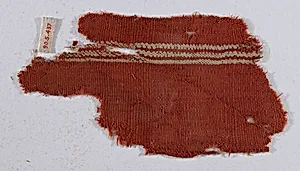
Medium
Wool, linen; plain weave
Dimensions
Max. H. 7 1/8 in. (18.1 cm) Max. W. 3 5/8 in. (9.2 cm)
Classification
Textiles
Department
Islamic Art
Museum
Metropolitan Museum of Art, New York, NY
Credit
Gift of George F. Baker, 1890
Accession Number
90.5.437
Rights
Public Domain
Art Historical Context
This delicate textile fragment, dating to the 4th–5th century, offers a glimpse into the everyday artistry of Late Antiquity in the Islamic world’s cultural precursors. Crafted from wool and linen in a plain weave—a simple yet sturdy technique where warp and weft threads interlace at right angles—it measures just 7⅛ by 3⅝ inches, likely a surviving piece from a larger garment, curtain, or furnishing. Such fragments were common in regions like Egypt or the Near East, where textiles practical and decorative purposes amid thriving trade routes. Its placement in the Metropolitan Museum of Art’s Islamic Art Department underscores the continuity of textile traditions that bridged pre-Islamic and early Islamic eras. Plain weave, accessible to artisans across social strata, highlights the ingenuity of ancient weavers who combined locally sourced wool for warmth and linen for breathability. Wool-linen blends were prized for durability in arid climates, reflecting sophisticated fiber knowledge passed down through generations. A generous gift from George F. Baker in 1890, this unassuming fragment invites us to appreciate the unsung heroes of history: anonymous craftspeople whose work clothed societies and adorned homes, preserving cultural threads across centuries.