
Textile Fragment
Unknown Artist
5th–6th century
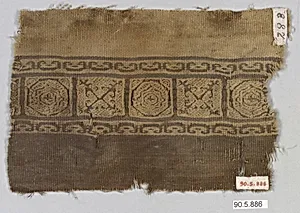
Medium
Wool
Dimensions
Max. H. 7 5/16 in. (18.5 cm) Max. W. 4 15/16 in. (12.5 cm)
Classification
Textiles
Department
Islamic Art
Museum
Metropolitan Museum of Art, New York, NY
Credit
Gift of George F. Baker, 1890
Accession Number
90.5.886
Rights
Public Domain
Art Historical Context
This delicate wool textile fragment, dating to the 5th–6th century, offers a glimpse into the sophisticated craftsmanship of Late Antiquity in the Islamic world. Measuring just 7 5/16 inches and 4 15/16 inches wide, it survives as a small remnant, likely from a larger garment tapestry, or decorative panel. Housed in the Metropolitan Museum of Art's Department of Islamic Art and gifted by George F. Baker in1890, it exemplifies enduring appeal of ancient textiles preserved through the ages. Wool, a practical and abundant medium in the arid regions of the Near East and North Africa, was woven with remarkable skill during this era. Techniques such as tapestry weave or embroidery—common in pre-Islamic societies like those in Sasanian Persia, Coptic Egypt, or Byzantine territories—produced vibrant, durable fabrics for daily life and elite adornment. Though details of its motifs are not specified, such fragments often featured geometric patterns, animals, or floral designs that foreshadowed the intricate iconography of later Islamic art. These textiles hold cultural significance as windows into trade networks, daily rituals, and artistic exchange along the Silk Road. Their survival underscores the ingenuity of ancient weavers, whose work bridged pagan, Christian, and emerging Islamic traditions, enriching our understanding of a transformative period.