
Textile Fragment
Unknown Artist
5th century
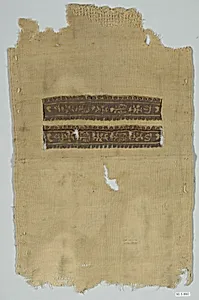
Medium
Wool
Dimensions
Max. H. 15 3/4 in. (40 cm) Max. W. 10 7/16 in. (26.5 cm)
Classification
Textiles
Department
Islamic Art
Museum
Metropolitan Museum of Art, New York, NY
Credit
Gift of George F. Baker, 1890
Accession Number
90.5.890
Rights
Public Domain
Art Historical Context
This delicate wool textile fragment, dating to the 5th, offers a rare glimpse into the artistry of early Islamic cultural regions. Measuring just 15¾ by 10⅜ inches (40 by 26.5 cm), it survives as a testament to the skilled weaving techniques of the era, when wool was a prized medium for its durability and versatility in garments, furnishings, and ceremonial objects. Housed in the Metropolitan Museum of Art's Art Department, it was generously gifted by George F. Baker in 1890, preserving a piece that might otherwise have faded into obscurity. Textiles like this were central to daily life and trade across the ancient Near East and beyond, often featuring intricate patterns that blended local traditions with emerging influences. Though the specific motifs are not detailed here, the fragment's survival highlights the sophistication of pre-Islamic and early Islamic weaving—hand-spun yarns meticulously interlaced on looms to create vibrant, functional art. Wool's natural properties allowed for bold dyes and textures, making such pieces both practical and prestigious. As visitors, imagine this small remnant once part of a larger tapestry or robe, carrying stories of nomads, merchants, and artisans from a transformative century. It invites us to appreciate the quiet endurance of textile heritage in Islamic art.