
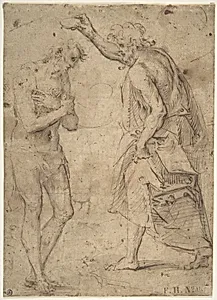
The Baptism of Christ
16th century
Medium
Pen and brown ink, brush and brown wash, over some traces of red chalk, glued to secondary paper support
Dimensions
9 1/2 x 6 13/16in. (24.1 x 17.3cm)
Classification
Drawings
Department
Drawings and Prints
Museum
Metropolitan Museum of Art, New York, NY
Credit
Bequest of Walter C. Baker, 1971
Accession Number
1972.118.13
Rights
Public Domain
Tags
Art Historical Context
In the tranquil scene of *The Baptism of Christ*, Italian artist Guglielmo Caccia, as Moncalvo (c. 1568–1625), captures a pivotal biblical moment from the New Testament. Here, John the Baptist immerses Jesus in the River Jordan as the Holy Spirit descends like a dove and God's voice affirms his sonship. Created in the late 16th century amid Italy's Mannerist era—a stylish evolution from the High Renaissance—Moncalvo work reflects the period's elongated figures and graceful compositions, blending spiritual devotion with artistic elegance. This intimate drawing, executed in pen and brown ink with brush and brown wash over faint traces of red chalk, exemplifies preparatory techniques favored by Renaissance and Mannerist masters. The fluid ink lines define forms with precision, while the subtle wash adds depth and atmosphere, evoking the rippling waters and divine light. At just 9½ x 6⅞ inches, its small scale invites close contemplation, a hallmark of studies meant for larger paintings or altarpieces. Glued to a secondary support, it speaks to centuries of careful preservation. Housed in the Metropolitan Museum of Art's Drawings and Prints department through the 1971 bequest of Walter C. Baker, this piece offers a window into Moncalvo's Lombard workshop practices and the enduring cultural reverence for Christ's baptism as a symbol of purification and revelation. A gem for drawing enthusiasts, it highlights how sketches like this bridged devotion and draftsmanship in Counter-Reformation Europe.
About the Artist
Moncalvo (Guglielmo Caccia) · 1568–1625
Guglielmo Caccia (1568–1625), known as Il Moncalvo after the Piedmontese town where he worked, stands as the most important exponent of Counter-Reformation art in Piedmont. Born on May 9, 1568, in Montabone near Acqui, Caccia earned the epithet 'the Raphael of Monferrato' for his elegant sacred paintings that successfully translated Counter-Reformation spiritual ideals into visual form. Working p...