
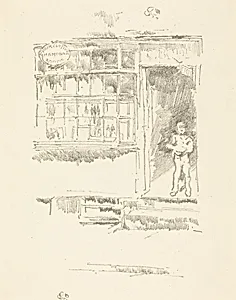
The Barber's Shop in the Mews
Medium
lithograph in black on laid paper
Dimensions
image: 19.2 × 12 cm (7 9/16 × 4 3/4 in.) sheet: 25.4 × 19.5 cm (10 × 7 11/16 in.)
Classification
Department
CG-W
Museum
National Gallery of Art, Washington, D.C.
Credit
Rosenwald Collection
Accession Number
1943.3.8763
Rights
Public Domain
Art Historical Context
Step into the everyday charm of late Victorian London with James McNeill Whistler'sThe Barber's Shop in Mews* (1896), a delicate black lithograph on laid paper. Measuring just 19.2 × 12 cm, this intimate print captures a humble barber's shop tucked into the mews—those narrow stable alleys behind grand homes, often alive with working-class trades. Whistler, the American-born expatriate famed for his "art for art's sake" Aestheticism and misty nocturnes, turned to lithography in his later years to evoke subtle atmospheres with remarkable fluidity. Lithography, a planographic technique where greasy crayon marks resist water on a stone, allowed Whistler to mimic the tonal softness of his oil paintings. Printed in black on textured laid paper, the image likely renders the shop's interior with his signature economy of line and shadow, distilling urban poetry from ordinary life. Produced during a prolific phase of over 100 lithographs, it reflects Whistler's fascination with London's underbelly, bridging fine art and commercial printmaking. Housed in the National Gallery of Art's Rosenwald Collection, this work exemplifies Whistler's innovative print legacy, influencing modern artists like Picasso. It's a window into 1890s street culture, reminding us how Whistler elevated the mundane to the masterful. (198 words)
About the Artist
James McNeill Whistler · 1834–1903
James Abbott McNeill Whistler (1834-1903) was an American-born painter and printmaker who became a leading figure in the Aesthetic Movement and pioneer of Tonalism and Japonisme. He revolutionized art by championing "art for art's sake" and treating paintings as visual equivalents of musical compositions, titling works as "arrangements," "harmonies," and "nocturnes" to emphasize formal qualities o...