
The Crucifixion
1340s
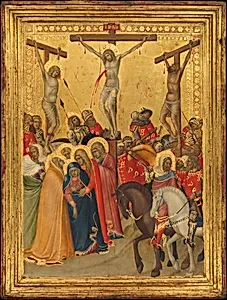
Medium
Tempera and gold leaf on wood
Dimensions
Overall 16 1/2 x 12 1/2 in. (41.9 x 31.8 cm); painted surface 14 1/8 x 10 1/8 in. (35.9 x 25.7 cm)
Classification
Paintings
Department
European Paintings
Museum
Metropolitan Museum of Art, New York, NY
Credit
Purchase, Lila Acheson Wallace Gift and Gwynne Andrews Fund, 2002
Accession Number
2002.436
Rights
Public Domain
Tags
Art Historical Context
Pietro Lorenzetti's *The Crucifixion*, created in the 1340s, exemplifies the refined elegance of Sienese Gothic painting during a golden age for the school in 14th-century Italy. As a leading figure alongside his brother Ambrogio, Lorenzetti crafted this intimate panel—measuring just over 16 by 12 inches—for private devotion, likely as part of a small altarpiece or portable artwork. Housed in the Metropolitan Museum of Art's European Paintings department since its 2002 acquisition, it captures the emotional intensity of Christ's Passion amid Siena's vibrant artistic rivalry with Florence. Rendered in tempera on a gold leaf ground, the work employs a traditional Italian technique that infuses the scene with divine radiance. The shimmering gold symbolizes heavenly light, while egg-based tempera allows for jewel-like colors and fine details. At the center, Christ hangs on the cross, flanked by the sorrowful Virgin Mary and saintly figures, with men, women, and horses—likely evoking Roman soldiers—adding narrative depth to the sacred drama. This poignant depiction reflects medieval piety's focus on human suffering and redemption, inviting viewers to contemplate faith amid life's trials. Lorenzetti's graceful figures and balanced composition bridge Gothic lyricism with emerging Renaissance naturalism, making it a gem for understanding pre-plague Tuscan devotion.