
The Crucifixion
ca. 1315
Medium
Tempera on panel
Dimensions
Left wing, overall, with engaged frame, 15 1/8 x 10 5/8 in. (38.4 x 27 cm); right wing, overall, with engaged frame, 15 x 10 5/8 in. (38.1 x 27 cm)
Classification
Paintings
Department
Robert Lehman Collection
Museum
Metropolitan Museum of Art, New York, NY
Credit
Robert Lehman Collection, 1975
Accession Number
1975.1.2
Rights
Public Domain
Tags
Art Historical Context
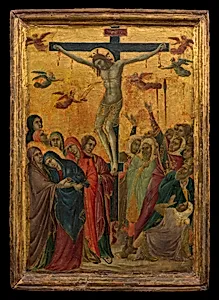
Segna di Buonaventura *The Crucifixion*, created around 1315, is a delicate diptych in tempera on panel, about 15 x 10 5/8 inches per wing. Housed in the Robert Lehman Collection at the Metropolitan Museum of Art, this artwork captures the pivotal Christian scene of Christ's death on the cross, surrounded by mourning angels, the Virgin Mary, and other holy figures. The engaged frames enhance its devotional purpose, suggesting it was designed for private prayer or personalarpieces common in medieval households. As a Sienese painter active in the early Trecento period, Segna worked in the vibrant Gothic style of Siena, Italy, influenced by masters like Duccio. Tempera, a durable medium of pigments mixed with egg yolk applied to wooden panels, allowed for luminous colors and fine details, often heightened with gold leaf to evoke the divine. This technique underscores the era's emphasis on spiritual emotion and narrative clarity, bridging Byzantine icons and emerging Renaissance naturalism. This diptych exemplifies Siena's golden age of painting, where religious imagery fostered deep faith amid turbulent times like the Black Death's shadow. Its small scale invites close contemplation, making it a treasured window into 14th-century devotion and artistic mastery.