
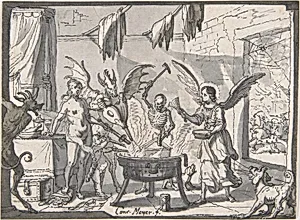
The Devil's Kitchen Visited by an Angel
mid-17th–late 17th century
Medium
Pen and gray ink, brush and gray wash
Dimensions
sheet: 3 3/4 x 5 1/8 in. (9.5 x 13 cm)
Classification
Drawings
Department
Drawings and Prints
Museum
Metropolitan Museum of Art, New York, NY
Credit
Purchase, Jean A. Bonna Gift, 2007
Accession Number
2007.223.25
Rights
Public Domain
Tags
Art Historical Context
In the mid-to-late 17th, Swiss artist Conrad Meyer crafted *The Devil's Kitchen Visited by an Angel*, captivating ink drawing that blends the macabre with the divine. Measuring just 3 3/4 x 5 1/8 inches, this intimate work on paper—executed in pen and gray ink with brush and gray wash—emplifies the meticulous draftsmanship of Baroque-era Northern European artists. Meyer's style, rooted in the detailed, narrative-driven tradition of the time, often explored allegorical themes, making this piece a window into 17th-century moral and spiritual imagination. The title evokes a hellish scene: a "devil's kitchen" teeming with skeletons and demonic figures, suddenly intruded upon by a radiant angel. This dramatic contrast likely symbolizes redemption, divine intervention, or the triumph of good over evil—themes central to Counter-Reformation art amid Europe's religious upheavals. Skeletons, common in vanitas motifs, remind viewers of mortality, while the angel offers hope, turning a gruesome tableau into a profound meditation on the soul's fate. Housed in the Metropolitan Museum of Art's Drawings and Prints department (purchased with the Jean A. Bonna Gift in 2007), this modest yet powerful sheet highlights the era's mastery of monochromatic techniques. The subtle grays build depth and atmosphere, inviting close inspection and rewarding contemplation of humanity's eternal struggle between darkness and light.
About the Artist
Conrad Meyer · 1618–1689
Comment on works: Portraits; Figures; Landscapes