
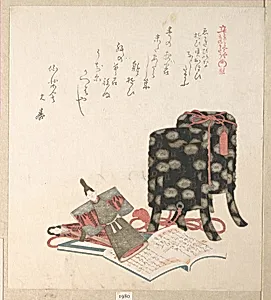
The Doll Festival, Third Day of the Third Month
19th century
Medium
Woodblock print (surimono); ink and color on paper
Dimensions
8 1/4 x 7 3/8 in. (21 x 18.7 cm)
Classification
Prints
Culture & Period
Japan · Edo period (1615–1868)
Department
Asian Art
Museum
Metropolitan Museum of Art, New York, NY
Credit
H. O. Havemeyer Collection, Bequest of Mrs. H. O. Havemeyer, 1929
Accession Number
JP1980
Rights
Public Domain
Tags
Art Historical Context
Kubo Shunman’s *The Doll Festival, Third of the Third Month*19th century) captures the joyful spirit of Japan’s Hina Matsuri or Doll Festival, celebrated on the third day of the third lunar month during the Edo period (1615–1868). This intimate woodblock print, or *surimono*, depicts dolls and books—key elements of the holiday when families displayed elaborate hina dolls representing the imperial court to pray for girls’ health and prosperity. As a privately commissioned print, it reflects the refined tastes of Kyoto’s literati circles, often featuring poetry alongside vivid imagery. Shunman, a master of ukiyo-e known for his poetic kyōka verses and delicate designs, employed sophisticated woodblock techniques: layered ink and color on paper, with subtle gradients (*bokashi*) and fine carving for texture. Measuring just 8¼ x 7⅜ inches, its small scale suited personal albums or New Year’s exchanges, emphasizing luxury over mass production. The print’s cultural significance lies in preserving Edo-era customs amid rapid urbanization, blending artistry with seasonal ritual. Part of the Metropolitan Museum of Art’s H. O. Havemeyer Collection, this gem invites visitors to appreciate how everyday festivals became timeless art, evoking the warmth of family traditions.
About the Artist
Kubo Shunman · 1757–1820
Japanese, 1757–1820