
Cleopatra
1524
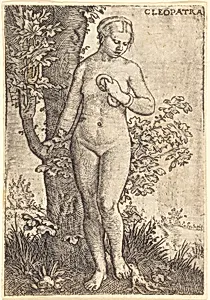
Medium
engraving on laid paper
Dimensions
sheet: 5.9 × 4.1 cm (2 5/16 × 1 5/8 in.)
Classification
Department
CG-E
Museum
National Gallery of Art, Washington, D.C.
Credit
Rosenwald Collection
Accession Number
1943.3.888
Rights
Public Domain
Art Historical Context
Behold the exquisite *Cleopatra*, a 1524 engraving by Bart Beham, one of the renowned "Little Masters" of the German Renaissance. Measuring just 5.9 × 4.1 cm on laid paper, this diminutive print packs intricate detail into a remarkably small format, now housed in the National Gallery of Art's Rosenwald Collection. Beham, active in Nuremberg alongside his brother Hans Sebald and under the shadow of Albrecht Dürer, mastered the art of capturing grandeur in miniature. Engraving, Beham's chosen medium, involved incising designs into a copper plate with a burin, inking it, and pressing it onto paper to produce sharp, precise lines. This technique revolutionized printmaking during the Northern Renaissance, making high-quality images affordable and widely collectible among scholars and enthusiasts. The laid paper, with its visible chain lines, adds to the period authenticity. *Cleopatra* reflects the era's fascination with classical antiquity, portraying the legendary Egyptian queen as a symbol of power, allure, and tragedy. Beham's precise style exemplifies the meticulous draftsmanship of the Kleinmeister (Little Masters), whose tiny works rivaled larger paintings in technical virtuosity and narrative depth—perfect for intimate study or jewelry-like adornment in 16th-century homes.
About the Artist
Barthel Beham · 1502–1540
Barthel Beham (1502–1540), a pivotal figure in the German Renaissance, was born in Nuremberg into a family of artists. The younger brother of the renowned engraver Hans Sebald Beham, he honed his craft under the tutelage of his elder sibling and the master Albrecht Dürer, absorbing the precise techniques of engraving and painting that defined Nuremberg's vibrant artistic scene. Emerging as a prodi...