
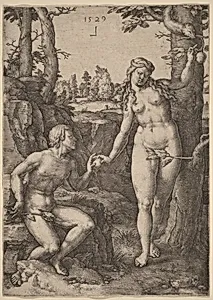
The Fall of Man
1529
Medium
engraving
Classification
Department
CG-E
Museum
National Gallery of Art, Washington, D.C.
Credit
Rosenwald Collection
Accession Number
1943.3.5667
Rights
Public Domain
Art Historical Context
**The Fall of Man**, masterful engraving by Dutch artist Lucas van Leyden in 1529, visitors into the dramatic world of Northern Renaissance printmaking. Housed in the National Gallery Art's CG-E department as part of the esteemed Rosenwald Collection, this print depicts the biblical story of Adam and Eve's expulsion from Eden—a timeless tale of temptation and consequence that resonated deeply in 16th-century Europe. Leyden, a prodigy engraver active in Leiden, excelled in the intaglio technique, using fine lines incised into copper plates to produce rich, detailed images that could be replicated widely. Engravings like this one democratized art, making sophisticated religious narratives accessible beyond elite patrons and fostering a shared visual culture during the Reformation era. Its classification as a print underscores the era's innovation in reproductive media, blending technical precision with profound moral storytelling. Pause here to appreciate how van Leyden's work bridges faith, artistry, and human frailty—a captivating highlight for any museum stroll! (168 words)
About the Artist
Lucas van Leyden · 1484–1533
Lucas van Leyden (1494–1533) was a Dutch painter and printmaker who stands among the greatest engravers of the Northern Renaissance. Born in Leiden as either Lucas Hugensz or Lucas Jacobsz, he lived and worked primarily in his native city, achieving international renown that rivaled the German master Albrecht Dürer. Lucas van Leyden revolutionized Netherlandish printmaking and was among the first...