
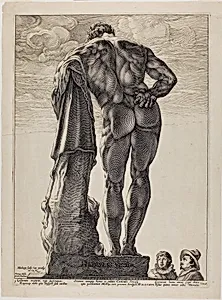
The Farnesian Hercules, plate one from Three Famous Antique Sculptures
c. 1592
Medium
Engraving on paper
Dimensions
Image: 39.8 × 29.3 cm (15 11/16 × 11 9/16 in.); Plate: 41.5 × 30 cm (16 3/8 × 11 13/16 in.); Sheet: 45 × 33.4 cm (17 3/4 × 13 3/16 in.)
Classification
engraving
Department
Prints and Drawings
Museum
Art Institute of Chicago
Accession Number
74120
Rights
Public Domain
About this artwork
On a long-awaited pilgrimage to Italy in 1590 and 1591, the great Haarlem Mannerist artist Hendrick Goltzius made many studies after ancient and modern sculpture. This ancient Greek statue of Hercules by Lysippus was unearthed and restored around 1550 and placed in the Farnese Palace. Goltzius engraved only three statues of a projected series, and these were not printed until after his death, around 1617.
Art Historical Context
Behold *The Farnesian Hercules*, the first plate from Hendrick Goltzius's celebrated series *Three Famous Antique Sculptures* (c. 1592). This masterful engraving captures the iconic Farnese Hercules, a colossal ancient marble statue rediscovered in the Renaissance and prized by the powerful Farnese family in Italy. Goltzius, a leading Dutch Mannerist engraver, transforms the Herculean figure—depicted in weary repose after his labors—into a dynamic print that rivals the sculpture's monumentality. Printed on paper with precise dimensions (image: 39.8 × 29.3 cm), this work exemplifies Goltzius's virtuosic technique. His swelling line work and dramatic chiaroscuro create a sense of bulging muscles and shadowed depths, mimicking three-dimensional stone in two dimensions. Engravings like this were revolutionary, democratizing access to classical antiquities for collectors and artists across Europe during the late 16th century. Housed in the Art Institute of Chicago's Prints and Drawings Department, this piece reflects the era's obsession with Greco-Roman ideals, bridging Italian Renaissance humanism with Northern innovation. Goltzius's print not only preserves the Farnese Hercules's grandeur but also inspires viewers to marvel at humanity's enduring fascination with heroic strength and classical beauty.
About the Artist
Hendrick Goltzius · 1558–1617
Hendrick Goltzius (1558–1617) was the most celebrated engraver of the Northern Renaissance and a pivotal figure in Dutch Mannerism. Born near the German-Dutch border, Goltzius transformed printmaking into a virtuoso art form through his revolutionary 'swelling line' technique, where the burin was manipulated to create lines of varying thickness that produced unprecedented tonal effects and three-d...