
The Four Seasons
mid to late 17th century
Medium
Etching and engraving
Dimensions
Sheet (Roundel): 11 3/4 × 11 13/16 in. (29.8 × 30 cm)
Classification
Prints
Department
Drawings and Prints
Museum
Metropolitan Museum of Art, New York, NY
Credit
Purchase, The Elisha Whittelsey Collection, The Elisha Whittelsey Fund, 1957
Accession Number
57.569.1
Rights
Public Domain
Tags
Art Historical Context
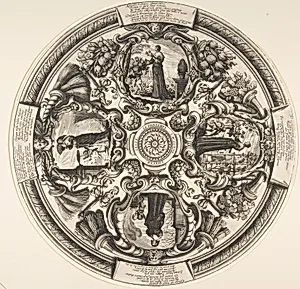
Abraham Bosse's *The Four Seasons*, created in the mid- to late 17th, is a captivating etching and engraving on a circular sheet measuring nearly 12 inches in diameter. French printmaker, active during the Baroque era, was renowned for his meticulous reproductive prints and innovative techniques, which he documented in influential treatises. The roundel format—uncommon for prints—lends a harmonious, mandala-like symmetry, inviting viewers to contemplate the cyclical nature of time. Personified by elegant female figures and overflowing cornucopias symbolizing abundance, the composition allegorically depicts spring, summer, autumn, and winter. Bosse's mastery of etching and engraving shines through in the fine lines and textures that convey seasonal details, from blooming flowers to harvest bounty. Such motifs were popular in 17th-century Europe, reflecting the era's fascination with nature's rhythms amid agricultural life and royal patronage. Acquired by The Metropolitan Museum of Art in 1957 through The Elisha Whittelsey Fund, this print exemplifies Bosse's role in democratizing art via affordable multiples. It offers a window into Baroque visual culture, blending classical allegory with technical virtuosity for enduring appeal.
About the Artist
Abraham Bosse · 1602–1676
Abraham Bosse (1604–1676) was a French printmaker and theorist whose approximately 1,600 etchings provide an unparalleled visual record of 17th-century French life. Born to Huguenot parents in Tours, he trained in Paris under Melchior Tavernier and became a devoted follower of Jacques Callot's technical innovations. Bosse's meticulous etchings depicted subjects ranging from daily life and fashion ...