
The Grapeleaf
1895
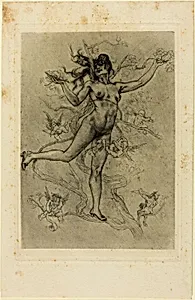
Medium
Heliogravure, with drypoint, on ivory laid paper
Dimensions
Image: 19.8 × 14 cm (7 13/16 × 5 9/16 in.); Plate: 21.6 × 15 cm (8 9/16 × 5 15/16 in.); Sheet: 27 × 17.4 cm (10 11/16 × 6 7/8 in.)
Classification
photogravure
Department
Prints and Drawings
Museum
Art Institute of Chicago
Accession Number
104329
Rights
Public Domain
Art Historical Context
### The Grapeleaf by Félicienops Nestled in the Prints and Drawings department the Art Institute of Chicago *The Grapeleaf* (1895) by Belgian Félicien Rops visitors into the intricate world of late 19th-century printmaking. Rops, a master of provocative and detailed etchings, crafted this intimate image—measuring just 19.8 × 14 cm—using heliogravure (a precise photogravure process) enhanced with drypoint on creamy ivory laid paper. The plate (21.6 × 15 cm) and sheet (27 × 17.4 cm) dimensions underscore its status as a refined collector's piece, perfect for close contemplation. Heliogravure, pioneered in the 19th century, combined photography's tonal subtlety with intaglio printing's depth, allowing Rops to achieve velvety textures and luminous effects unattainable in earlier techniques. The addition of drypoint—direct scratches on the plate—added burr-rich lines for a tactile, spontaneous quality. This fusion highlights the era's technological leap in reproductive prints, making high-fidelity art accessible beyond paintings. At the fin-de-siècle cusp, *The Grapeleaf* reflects printmaking's golden age, where artists like Rops pushed boundaries of light, shadow, and natural motifs. Pause here to appreciate how this delicate work captures the ephemeral beauty of a single leaf, bridging observation and artistry in a single, elegant sheet. (198 words)
About the Artist
Félicien Rops · 1833–1898
Félicien Rops, born Félicien Victor Joseph Rops on July 7, 1833, in Namur, Belgium, to a prosperous textile manufacturing family, displayed prodigious artistic talent from youth. The only child of Nicholas Rops and Sophie Maubile, he received private tutoring until age ten, followed by education at a Jesuit school in Namur (1843–1848), the Athénée Royal de Namur, and the Academy of Fine Arts there...