
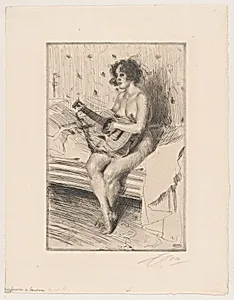
The Guitar Player
1900
Medium
Etching; fourth state of four
Dimensions
Plate: 9 3/8 × 6 1/4 in. (23.8 × 15.9 cm) Sheet: 12 15/16 × 10 1/16 in. (32.9 × 25.5 cm)
Classification
Prints
Department
Drawings and Prints
Museum
Metropolitan Museum of Art, New York, NY
Credit
Harris Brisbane Dick Fund, 1917
Accession Number
17.3.686
Rights
Public Domain
Tags
Art Historical Context
Anders Zorn's *The Guitar Player* (1900) is a captivating etching that exemplifies the Swedish artist's mastery of printmaking during the fin-de-siècle era. Zorn, renowned for his luminous portraits and intimate nudes, often drew inspiration from everyday moments infused with sensuality and grace. Here, a female figure—nude and absorbed in music—embodies his fascination with the female form in relaxed, natural poses, evoking a sense of quiet harmony amid the cultural vibrancy of Europe's Belle Époque. This work is the fourth and final state of four in the etching process, where Zorn refined his lines through meticulous biting of the copper plate with acid. The medium's intimacy—plate size just 9 3/8 × 6 1/4 inches—allowed for exquisite detail in textures like the guitar's curves and the model's flowing hair, showcasing his virtuoso technique in capturing light, shadow, and flesh tones. Etchings like this were prized for their reproducibility yet retained a painterly quality unique to Zorn's hand. Acquired in 1917 through the Harris Brisbane Dick Fund and now housed in the Metropolitan Museum of Art's Drawings and Prints department, *The Guitar Player* highlights Zorn's international acclaim and the era's appreciation for music, leisure, and the nude as symbols of beauty and freedom. A gem for print enthusiasts, it invites visitors to savor the delicate interplay of line and tone.
About the Artist
Anders Zorn · 1860–1920
Anders Zorn (1860–1920), one of Sweden's most celebrated artists, was born on February 18 in Utmeland near Mora in Dalarna, and raised on his maternal grandparents' farm in the nearby hamlet of Yvraden. Displaying prodigious talent from a young age, he attended school in Mora Strand until age twelve, followed by secondary grammar school in Enköping, where he excelled in drawing people and horses. ...