
The Hundred Guilder Print
ca. 1649
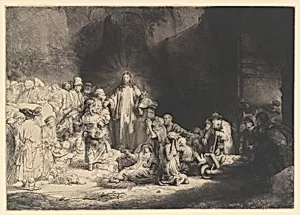
Medium
Etching, engraving, and drypoint; second state of two
Dimensions
plate: 11 x 15 1/2 in. (28 x 39.3 cm)
Classification
Prints
Department
Drawings and Prints
Museum
Metropolitan Museum of Art, New York, NY
Credit
H. O. Havemeyer Collection, Bequest of Mrs. H. O. Havemeyer, 1929
Accession Number
29.107.35
Rights
Public Domain
Tags
Art Historical Context
Welcome to *The Hundred Guilder Print a masterpiece of printmaking by the Dutch artist Rembrandt van Rijn, around 1649. This etching, engraving, and drypoint on a plate measuring 11 x 15½ inches captures a biblical scene featuring Jesus surrounded by men and women,oking the humanity and drama characteristic of Rembrandt's Baroque style. As one of his most celebrated prints, it showcases his unparalleled ability to convey light, shadow, and emotion through intricate line work. Rembrandt masterfully combined etching (using acid to bite into the metal plate), engraving (precise incising with a burin), and drypoint (direct scratching for velvety burr lines), creating rich textures and tonal depth in this second state of two. These techniques allowed for subtle gradations and atmospheric effects, revolutionizing printmaking during the Dutch Golden Age and making his works highly prized even in his lifetime—hence the evocative title referencing its legendary value. Today, this gem resides in the Metropolitan Museum of Art's Drawings and Prints department, part of the H.O. Havemeyer Collection bequeathed in 1929. It invites visitors to marvel at Rembrandt's genius in transforming a small plate into a window on profound human stories.
About the Artist
Rembrandt (Rembrandt van Rijn) · 1606–1669
Rembrandt Harmenszoon van Rijn (1606–1669) stands as one of the greatest visual artists in the history of Western art and the most important Dutch painter of the 17th century. Born in Leiden to a prosperous miller's family, Rembrandt transformed painting through his revolutionary use of light and shadow, his psychological depth in portraiture, and his elevation of etching to a fine art. His approx...