
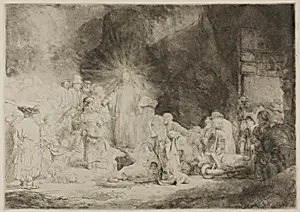
The Hundred Guilder Print
c. 1648
Medium
Etching and drypoint on off-white laid paper
Dimensions
Sheet trimmed to platemark: 27.8 × 39.5 cm (11 × 15 9/16 in.)
Classification
etching
Department
Prints and Drawings
Museum
Art Institute of Chicago
Accession Number
49005
Rights
Public Domain
Art Historical Context
Rembrandt van Rijn's *The Hundred Guilder Print*, created around 1648, stands as one of the crowning achievements of Dutch Golden Age printmaking. This etching captures a bustling biblical scene from the Gospel of Matthew, where Christ heals the sick amid a throng of supplicants, showcasing Rembrandt's profound empathy for humanity. At 27.8 × 39.5 cm, its intimate scale belies the monumental complexity, with over 200 figures rendered in exquisite detail on off-white laid paper. Rembrandt revolutionized etching and drypoint techniques here, layering fine etched lines with the velvety burr of drypoint to achieve dramatic chiaroscuro—deep shadows contrasting luminous highlights. This innovative approach allowed unprecedented tonal richness, making each impression uniquely textured and alive, a hallmark of his Baroque mastery. Nicknamed for its extraordinary value—one early sale fetched 100 guilders, a small fortune—the print's renown endures. Housed in the Art Institute of Chicago's Prints and Drawings Department, it invites visitors to marvel at Rembrandt's genius in transforming paper into a window on the divine and the everyday.
About the Artist
Rembrandt van Rijn · 1606–1669
Rembrandt Harmenszoon van Rijn (1606–1669) stands as one of the greatest visual artists in the history of Western art and the most important Dutch painter of the 17th century. Born in Leiden to a prosperous miller's family, Rembrandt transformed painting through his revolutionary use of light and shadow, his psychological depth in portraiture, and his elevation of etching to a fine art. His approx...