
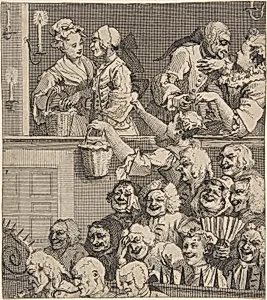
The Laughing Audience
December 1733
Medium
Etching; fourth state of four
Dimensions
sheet (trimmed within plate): 6 7/8 x 6 1/8 in. (17.4 x 15.5 cm)
Classification
Prints
Department
Drawings and Prints
Museum
Metropolitan Museum of Art, New York, NY
Credit
Harris Brisbane Dick Fund, 1932
Accession Number
32.35(70)
Rights
Public Domain
Tags
Art Historical Context
**The Laughing Audience** is a witty etching by William Hogarth, the pioneering English satirist, created in December 1733. This print (6 7/8 x 6 1/8 in.), in its fourth and final state, captures a boisterous crowd of men and women spectators mid-laugh, likely mocking the fickle theater audiences of 18th-century London. Hogarth, renowned for his moralistic series like *A Harlot's Progress*, used such works to skewer social vices with sharp observation and humor, blending Rococo elegance with gritty realism. As an etching—a technique Hogarth mastered for affordable, widespread distribution—this piece exemplifies his innovative printmaking. The "fourth state" refers to the final version after refinements, allowing subtle details in facial expressions and exaggerated gestures to shine, heightening the satire. Produced during a vibrant era of English theater, it reflects cultural tensions around public entertainment, where crowds could elevate or demolish performers on a whim. Housed in the Metropolitan Museum of Art's Drawings and Prints department, *The Laughing Audience* invites us to chuckle at our own performative natures. Hogarth's enduring legacy lies in making art accessible, turning everyday follies into timeless commentary. (198 words)
About the Artist
William Hogarth · 1697–1764
William Hogarth (1697-1764) was an English painter, printmaker, and pictorial satirist who became the first great English-born artist to attract admiration abroad. Born into poverty in London, the son of a failed schoolmaster who was imprisoned for debt, Hogarth's early experiences with the harsh realities of 18th-century urban life profoundly shaped his artistic vision. After apprenticing with si...