
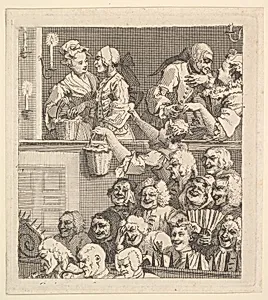
The Laughing Audience
December 1733
Medium
Etching; fourth state four
Dimensions
plate: 7 1/2 x 6 13/16 in. (19 x 17.3 cm) sheet: 7 15/16 x 7 1/8 in. (20.1 x 18.1 cm)
Classification
Prints
Department
Drawings and Prints
Museum
Metropolitan Museum of Art, New York, NY
Credit
Gift of Sarah Lazarus, 1891
Accession Number
91.1.37
Rights
Public Domain
Tags
Art Historical Context
William Hogarth's *The Laughing Audience*1733) is a sharp satirical etching that captures the rowdy energy of an 18th-century theater. Created as the fourth state of a print plate measuring about 7½ x 6⅞ inches, this work exemplifies Hogarth's mastery of the etching medium, allowing for intricate details in facial expressions and chaotic compositions. Housed in the Metropolitan Museum of Art's Drawings and Prints department, reflects the artist's early career focus on social commentary through accessible printmaking. Set against the vibrant backdrop of London's burgeoning theater scene, the print mocks spectators—men and women alike—who laugh uproariously, likely at a dramatic or moralistic play. Hogarth, a pioneer of English satirical art influenced by the Rococo style yet distinctly moralistic, used such scenes to critique shallow tastes and public folly. This piece highlights the cultural divide between refined art and popular entertainment in Georgian England, where theaters were hotbeds of class mixing and boisterous reactions. Its enduring appeal lies in Hogarth's biting wit and technical precision, making high art from everyday vice. Donated to the Met in 1891, it invites visitors to chuckle at our own audience behaviors across centuries.
About the Artist
William Hogarth · 1697–1764
William Hogarth (1697-1764) was an English painter, printmaker, and pictorial satirist who became the first great English-born artist to attract admiration abroad. Born into poverty in London, the son of a failed schoolmaster who was imprisoned for debt, Hogarth's early experiences with the harsh realities of 18th-century urban life profoundly shaped his artistic vision. After apprenticing with si...