
The Poor Fisherman (Le Pauvre pêcheur)
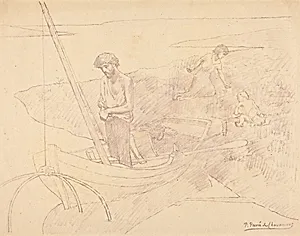
Medium
lithograph in purple on laid paper
Dimensions
overall: 43.3 × 57.3 cm (17 1/16 × 22 9/16 in.)
Classification
Department
CG-E
Museum
National Gallery of Art, Washington, D.C.
Credit
Print Purchase Fund (Rosenwald Collection)
Accession Number
1975.16.1
Rights
Public Domain
Art Historical Context
Pierre Puvis de Chavannes, a pivotal French Symbolist artist (1824–1898), crafted *The Poor Fisherman (Le Pauvre pêcheur)* in 1897 as a striking lithograph printed in soft purple tones on laid paper. Measuring43.3 × 57.3 cm, this work exemplifies Puvis's signature style: ethereal, dreamlike compositions that blend classical simplicity with poetic melancholy. Known for grand mural cycles in public buildings like the Panthéon in Paris, Puvis here translates his vision to print, portraying the humble dignity of everyday life amid nature's quiet vastness. Lithography, a 19th-century planographic technique, suited Puvis perfectly, allowing fluid lines and subtle tonal gradations that mimic his oil paintings' velvety surfaces. The unusual purple monochrome evokes a mystical twilight, heightening the emotional resonance of the solitary fisherman's plight—a theme Puvis often explored to celebrate spiritual resilience over material wealth. This print reflects Symbolism's emphasis on inner truths and influenced modernists like Gauguin and Seurat. Acquired via the National Gallery of Art's Print Purchase Fund (Rosenwald Collection), *The Poor Fisherman* invites visitors to ponder humanity's quiet struggles, bridging 19th-century idealism with timeless empathy.
About the Artist
Pierre Puvis de Chavannes · 1824–1898
Pierre Puvis de Chavannes (1824–1898) was a French painter who became the foremost muralist of nineteenth-century France and a crucial bridge between academic tradition and modernism. Born in Lyon to a prosperous family, he studied briefly with Henri Scheffer and Thomas Couture in Paris and traveled to Italy, where the frescoes of the Italian Renaissance made a lasting impression on his artistic v...