
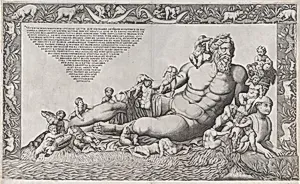
Speculum Romanae Magnificentiae: The Nile
mid-16th century
Medium
Engraving; first state of three
Dimensions
sheet: 13 x 21 1/16 in. (33 x 53.5 cm) plate: 18 5/16 x 21 1/16 in. (46.5 x 53.5 cm)
Classification
Prints
Department
Drawings and Prints
Museum
Metropolitan Museum of Art, New York, NY
Credit
Harris Brisbane Dick Fund, 1941
Accession Number
41.72(2.98)
Rights
Public Domain
Tags
Art Historical Context
Nicolas Beatrizet’s engraving *The Nile*, created in the mid-16th century, belongs to the celebrated series *Speculum Romanae Magnificentiae*Mirror of Roman Magnificence”). This ambitious project compiled prints of ancient Roman monuments and sculptures, allowing viewers across Europe to study the classical past without traveling to Italy. Beatrizet, a French engraver working in Rome, specialized in translating monumental sculptures into detailed prints that captured both their grandeur and intricate surfaces. The image depicts the famous ancient marble statue of the Nile river god, now in the Vatican Museums. Surrounded by playful children and animals, the reclining figure symbolizes the river’s life-giving fertility and the abundance of Egypt. Through precise line work and careful shading, the engraving conveys the sculpture’s dynamic composition and rich textures, inviting close inspection of its symbolic details. As one of the earliest states of the print, this work highlights the technical sophistication of Renaissance engraving. The medium allowed artists to reproduce celebrated antiquities with remarkable fidelity, spreading knowledge of classical art and fueling the period’s renewed fascination with Rome’s heritage.
About the Artist
Nicolas Beatrizet · 1515–1566
Nicolas Beatrizet, born around 1515 in Lunéville, Lorraine (then part of the Holy Roman Empire), emerged as one of the most prolific French engravers of the 16th century. Little is known about his early life and training, with no records of specific teachers or apprenticeships, though regional influences from German and Italian printmaking likely shaped his skills before he arrived in Rome around ...