
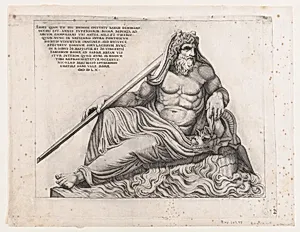
Speculum Romanae Magnificentiae: The Ocean God
Medium
Engraving; second state of three (Robert-Dumesnil)
Dimensions
sheet: 13 9/16 x 17 3/8 in. (34.5 x 44.2 cm) plate: 12 3/8 x 16 5/16 in. (31.5 x 41.5 cm)
Classification
Prints
Department
Drawings and Prints
Museum
Metropolitan Museum of Art, New York, NY
Credit
Harris Brisbane Dick Fund, 1941
Accession Number
41.72(2.95)
Rights
Public Domain
Tags
Art Historical Context
Nicolas Beatrizet’s 1560 engraving, *The Ocean God*, belongs to the celebrated seriesSpeculum Romanae Magnificentiae* (“Mirror of Roman Magnence”), a visual compendium of ancient Roman antiquities that circulated widely across Europe. Working in Rome during the height of the Renaissance, the French-born printmaker captured classical statues and reliefs with remarkable precision, allowing viewers far from Italy to study the city’s sculptural heritage. The subject depicts Oceanus, the ancient Titan personifying the sea, rendered in the monumental style typical of Roman public fountains and architectural sculpture. Beatrizet’s meticulous engraving technique translates the stone’s textures and dramatic musculature into fine lines, making the divine figure appear both powerful and lifelike on the printed page. As a reproductive print issued in multiple states, this work exemplifies how sixteenth-century engravings served as portable ambassadors of classical culture. Acquired by the Metropolitan Museum through the Harris Brisbane Dick Fund, it continues to offer modern audiences an intimate connection to the Renaissance fascination with Rome’s enduring artistic legacy.
About the Artist
Nicolas Beatrizet · 1515–1566
Nicolas Beatrizet, born around 1515 in Lunéville, Lorraine (then part of the Holy Roman Empire), emerged as one of the most prolific French engravers of the 16th century. Little is known about his early life and training, with no records of specific teachers or apprenticeships, though regional influences from German and Italian printmaking likely shaped his skills before he arrived in Rome around ...