
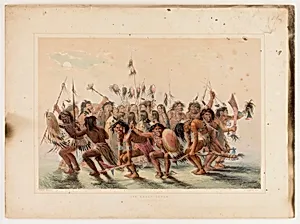
The Scalp Dance
Medium
Graphic Arts-Print
Classification
Graphic Arts-Print
Department
Smithsonian Collection
Museum
Smithsonian American Art Museum
Credit
Smithsonian American Art Museum, Transfer from the National Museum of Natural History, Department of Ethnology, Smithsonian Institution
Accession Number
1985.66.386,595D
Rights
Public Domain
Tags
Art Historical Context
**The Scalp Dance** by George Catlin captures a vivid moment from Native American life on the Great Plains, showcasing the artist's lifelong dedication to documenting Indigenous cultures. Catlin, a pioneering 19th-century painter, traveled extensively among tribes in the 1830s, creating hundreds of portraits and scenes before these traditions were profoundly altered by westward expansion. This graphic arts print, likely a reproduction of one of his oil paintings, depicts a group of figures engaged in the intense "Scalp Dance"—a ceremonial ritual where women triumphantly paraded enemy scalps, symbolizing victory and communal strength. As a print medium, the work exemplifies Catlin's innovative use of lithography to make his observations accessible to a wide audience through books like his *Letters and Notes on the Manners, Customs, and Conditions of the North American Indians* (1841). The composition emphasizes dynamic movement and expressive figures, highlighting the cultural and spiritual significance of such dances in Plains tribes, which reinforced social bonds and warrior honor. Housed in the Smithsonian American Art Museum, *The Scalp Dance* stands as a poignant historical record, inviting visitors to reflect on the resilience of Native traditions amid rapid change. Though the exact date is unknown, it embodies Catlin's urgent mission to preserve a vanishing world through art.
About the Artist
George Catlin · 1796–1872
George Catlin (1796–1872), born in Wilkes-Barre, Pennsylvania, to Putnam Catlin and Polly Sutton—who had been captured by Native Americans during the 1778 Battle of Wyoming—initially pursued a legal career. Trained at Litchfield Law School, he was admitted to the bar in 1819 but abandoned law after two years to study art in Philadelphia in 1823. Self-taught as a portraitist, Catlin quickly gained ...