
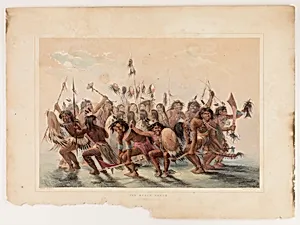
The Scalp Dance
Medium
Graphic Arts-Print
Classification
Graphic Arts-Print
Department
Smithsonian Collection
Museum
Smithsonian American Art Museum
Credit
Smithsonian American Art Museum, Transfer from the National Museum of Natural History, Department of Ethnology, Smithsonian Institution
Accession Number
1985.66.386,595G
Rights
Public Domain
Tags
Art Historical Context
**The Scalp Dance** by George Catlin captures a vivid moment from Native American ceremonial life, depicting a group of figures engaged in the traditional "Scalp Dance." This, often performed by Plains Indian women, celebrated victory in battle, with dancers holding aloft scalps as symbols of triumph and communal honor. Catlin, pioneering 19th-century American artist documented such customs during his extensive travels among tribes in the 183s, creating an invaluable visual record before rapid cultural changes altered these practices forever. As a graphic arts print from the Smithsonian American Art Museum's collection, the work reflects Catlin's commitment to authenticity and advocacy. He produced thousands of sketches and paintings to preserve Indigenous cultures threatened by westward expansion, later reproducing them as prints for wider audiences. This medium allowed his detailed observations—rich in movement, costume, and emotion—to reach scholars, policymakers, and the public, fostering early appreciation for Native traditions. Though the exact date is unknown, *The Scalp Dance* embodies Catlin's Romantic style, blending ethnographic precision with dramatic storytelling. It's a poignant reminder of resilience and ritual, inviting visitors to reflect on the human stories behind history's margins. (198 words)
About the Artist
George Catlin · 1796–1872
George Catlin (1796–1872), born in Wilkes-Barre, Pennsylvania, to Putnam Catlin and Polly Sutton—who had been captured by Native Americans during the 1778 Battle of Wyoming—initially pursued a legal career. Trained at Litchfield Law School, he was admitted to the bar in 1819 but abandoned law after two years to study art in Philadelphia in 1823. Self-taught as a portraitist, Catlin quickly gained ...