
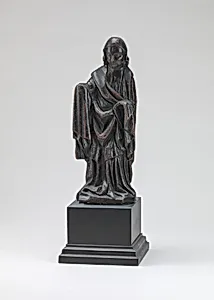
The Virgin of the Annunciation
19th century
Medium
bronze
Dimensions
overall: 17.2 x 6.7 x 4.3 cm (6 3/4 x 2 5/8 x 1 11/16 in.) base (height): 5.9 cm (2 5/16 in.)
Classification
Sculpture
Department
CSD
Museum
National Gallery of Art, Washington, D.C.
Credit
Samuel H. Kress Collection
Accession Number
1957.14.30
Rights
Public Domain
Art Historical Context
This delicate bronze sculpture, titled *The Virgin of the Annunciation*, captures a pivotal moment from the Christian story in which the angel Gabriel announces to Mary that she will bear the son of God. Created in 19th-century France, the small figure—measuring just over six inches tall—reflects the period’s renewed interest in religious subjects for both private devotion and refined collecting. The unknown artist has rendered Mary in a moment of quiet contemplation, her gentle pose and flowing drapery conveying humility and grace. Bronze was a favored medium during this era for its ability to hold intricate details while offering durability and a warm, luminous surface. French sculptors often drew on medieval and Renaissance traditions, adapting them to the tastes of 19th-century audiences who valued both spiritual themes and technical mastery. The sculpture’s modest scale suggests it was intended for intimate settings, allowing viewers to appreciate its fine modeling up close. Now part of the National Gallery of Art’s Samuel H. Kress Collection, this work exemplifies how 19th-century artists bridged historical religious imagery with contemporary craftsmanship, inviting quiet reflection on a timeless narrative.