
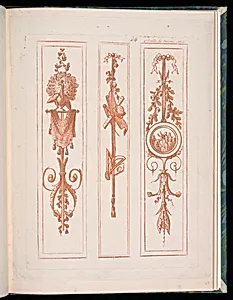
Three Arabesque Panel Designs
Classification
Department
Smithsonian Collection
Museum
Smithsonian American Art Museum
Credit
Purchased for the Museum by the Advisory Council
Accession Number
1921-6-481-39
Rights
Public Domain
About this artwork
Research in Progress
Art Historical Context
**Three Arabesque Panel Designs Jean-Baptiste Huet (1745–1811), a leading French artist of the late Rococo era, created these enchanting *Three Arabesque Panel Designs* between1776 and 1789. Acquired by the Smithsonian American Art Museum the Advisory Council, this reflects the opulent decorative tastes of pre-Revolutionary France, where arabesques—intricate, flowing motifs of intertwined foliage, figures, and fantastical elements—adorned walls, furniture, and porcelain. Huet's signature style blended playful Rococo whimsy with emerging Neoclassical refinement, often drawing from nature's grace. As a print, likely an etching or engraving, it served as a practical template for artisans, disseminating elite designs for broader use in interiors and luxury goods. Huet frequently collaborated with royal manufactories like Sèvres and Gobelins, making his work a bridge between fine art and everyday elegance. Though research is ongoing, these panels invite us to marvel at 18th-century France's love for harmonious fantasy, evoking the salons of Versailles in delicate, swirling lines. A testament to Huet's enduring influence on decorative arts! *(178 words)*