
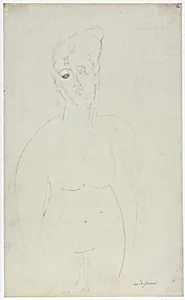
Torso of a Nude Woman
ca. 1918
Medium
Graphite on paper
Dimensions
17 1/8 × 10 3/8 in. (43.5 × 26.4 cm)
Classification
Drawings
Department
Modern and Contemporary Art
Museum
Metropolitan Museum of Art, New York, NY
Credit
Gift of Bella and Sol Fishko, 1982
Accession Number
1982.503
Rights
Public Domain
Tags
Art Historical Context
Amedeo Modigliani *Torso of a Nude Woman* (ca. 1918) captures the artist's signature fascination with the female form through a delicate graphite drawing on paper. Measuring 17 1/8 × 10 3/8 inches, this intimate study exemplifies Modigliani's modernist style characterized by elongated proportions and graceful curves that evoke both classical sculpture and sensual modernity. Working in Paris amid the Bohemian circles of Montparnasse, Modigliani numerous such preparatory sketches and standalone works during World War I, often exploring the nude as a symbol of timeless beauty and human vulnerability. The drawing's artistic significance lies in its economical use of graphite—soft shading and fluid lines that model the torso's volume and subtle musculature, highlighting Modigliani's mastery of line as both contour and emotion. Part of his late series of female nudes, it reflects influences from African masks and Italian Renaissance art, blended into a uniquely personal expressionism. Though less famous than his paintings, these drawings reveal the raw process behind his iconic elongations. Today, this piece graces the Metropolitan Museum of Art's Modern and Contemporary Art department, a gift from Bella and Sol Fishko in 1982. It invites visitors to appreciate Modigliani's brief but brilliant career—he died in 1920 at age 35—offering a window into early 20th-century Paris's vibrant avant-garde scene.
About the Artist
Amedeo Modigliani · 1884–1920
Amedeo Modigliani (1884–1920) was an Italian painter and sculptor whose elegant, elongated figures and portraits rank among the most instantly recognizable images in modern art. Born in Livorno, Tuscany, to a Sephardic Jewish family, he studied at the academies of Florence and Venice before moving permanently to Paris in 1906, where he immersed himself in the bohemian artistic milieu of Montmartre...