
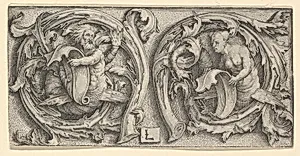
Triton and Siren in Tendrils
ca. 1510
Medium
Engraving
Dimensions
sheet: 2 3/16 x 4 3/8 in. (5.6 x 11.1 cm)
Classification
Prints
Department
Drawings and Prints
Museum
Metropolitan Museum of Art, New York, NY
Credit
Harris Brisbane Dick Fund, 1927
Accession Number
27.23.85
Rights
Public Domain
Tags
Art Historical Context
Lucas van Leyden, a pioneering Dutch artist of the Northern Renaissance, created this delicate engraving around 1510. Known for his mastery of printmaking a young age, van Leyden often drew on classical mythology to explore themes of nature, desire, and the sea. Here, the half-man, half-fish Triton embraces a siren amid swirling tendrils, blending human and aquatic forms in a compact, intimate composition. As an engraving, the work highlights the medium’s rising importance in the early sixteenth century. The fine lines and intricate details allowed van Leyden to capture both the sinuous movement of the figures and the decorative foliage that frames them, making the tiny sheet—barely larger than a playing card—feel remarkably alive. Such prints circulated widely among collectors, helping spread Renaissance interest in antique myths across northern Europe. Acquired by the Metropolitan Museum of Art in 1927, “Triton and Siren in Tendrils” exemplifies van Leyden’s skill at distilling powerful narratives into small, exquisite formats. The work invites viewers to appreciate how Renaissance artists transformed ancient legends into fresh, visually engaging imagery that continues to captivate audiences today.
About the Artist
Lucas van Leyden · 1484–1533
Lucas van Leyden (1494–1533) was a Dutch painter and printmaker who stands among the greatest engravers of the Northern Renaissance. Born in Leiden as either Lucas Hugensz or Lucas Jacobsz, he lived and worked primarily in his native city, achieving international renown that rivaled the German master Albrecht Dürer. Lucas van Leyden revolutionized Netherlandish printmaking and was among the first...