
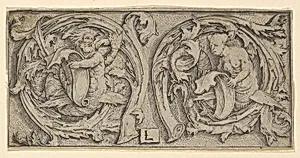
Triton and Siren in Tendrils
ca. 1510
Medium
Engraving
Classification
Prints
Department
Drawings and Prints
Museum
Metropolitan Museum of Art, New York, NY
Credit
Gift of Harry G. Friedman, 1962
Accession Number
62.635.846
Rights
Public Domain
Tags
Art Historical Context
In the early 16th century, artist Lucas van Leyden emerged as a prodigy of the Northern Renaissance, renowned for his masterful engravings that rivaled the works of Albrecht Dürer Created around 1510, *Triton and Siren in Tend* exemplifies his skill in capturing intricate mythological scenes on a small scale. This engraving, housed in the Metropolitan Museum of's Drawings and Prints departmentgift of Harry G. Friedman, 2), draws from classical lore, depicting the sea god Triton—half-man, half-fish—and a seductive siren entwined in flowing tendrils, evoking the perilous allure of the ocean depths. Van Leyden's engraving technique shines here: using a burin on a copper plate, he achieved extraordinary fine lines and textures, rendering watery waves, scaly skin, and sinuous forms with remarkable precision. This medium was revolutionary, allowing detailed images to be reproduced and widely shared, democratizing art during the Renaissance. Culturally, the print reflects the era's fascination with ancient myths amid growing humanism, blending Northern detail with classical themes. Visitors will appreciate its dynamic composition—a testament to van Leyden's innovative spirit before his early death at age 39.
About the Artist
Lucas van Leyden · 1484–1533
Lucas van Leyden (1494–1533) was a Dutch painter and printmaker who stands among the greatest engravers of the Northern Renaissance. Born in Leiden as either Lucas Hugensz or Lucas Jacobsz, he lived and worked primarily in his native city, achieving international renown that rivaled the German master Albrecht Dürer. Lucas van Leyden revolutionized Netherlandish printmaking and was among the first...