
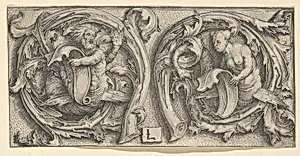
Triton and Siren in Tendrils
1510
Medium
Engraving
Dimensions
sheet: 2 1/8 x 4 3/8 in. (5.4 x 11.1 cm)
Classification
Prints
Department
Drawings and Prints
Museum
Metropolitan Museum of Art, New York, NY
Credit
Harris Brisbane Dick Fund, 1933
Accession Number
33.56.58
Rights
Public Domain
Tags
Art Historical Context
Behold *Triton and Siren in Tendrils*, a engraving by the Dutch master Lucas van Leyden, created around 1510. This sheet, measuring just 2 1/8 x 4 3/8 inches, captures a mythical underwater embrace: the sea god Triton, half-man half-fish, entw with a seductive siren amid swirling tendrils of seaweed. Van Leyden, a prodigy born in Leiden in 1494, was a leading figure in the Northern Renaissance, renowned for his intricate prints that rivaled those of Albrecht Dürer. Engraving, van Leyden's specialty, involved incising fine lines into a copper plate with a burin, allowing for exceptional detail and tonal depth in black-and-white. This technique made his works affordable and widely collectible, spreading Renaissance humanism and classical mythology across Europe. Here, the mythological duo evokes ancient tales from Ovid and Homer—Triton as Poseidon's herald, sirens as enchanting dangers—blending eroticism with the fantastical in a compact, jewel-like composition. Acquired through the Harris Brisbane Dick Fund in 1933, this print from the Metropolitan Museum of Art's Drawings and Prints department exemplifies early 16th-century innovation in printmaking, bridging medieval fantasy with emerging naturalism. A tiny window into van Leyden's genius!
About the Artist
Lucas van Leyden · 1484–1533
Lucas van Leyden (1494–1533) was a Dutch painter and printmaker who stands among the greatest engravers of the Northern Renaissance. Born in Leiden as either Lucas Hugensz or Lucas Jacobsz, he lived and worked primarily in his native city, achieving international renown that rivaled the German master Albrecht Dürer. Lucas van Leyden revolutionized Netherlandish printmaking and was among the first...