
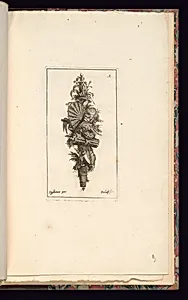
Trophy Design
late 18th century
Classification
Department
Smithsonian Collection
Museum
Smithsonian American Art Museum
Credit
Purchased for the Museum by the Advisory Council
Accession Number
1921-6-295-9
Rights
Public Domain
About this artwork
Research in Progress
Art Historical Context
Jean-Charles Delafosse a prominent French artist (17341789), created this *Trophy Design* in late 18th century a period when France transitioned from the Rococo style to the restrained Neoclassicism. As a skilled engraver and ornamental designer, Delafosse in intricate prints that served as pattern books for architects, furniture makers, and decorators. These "trophies"—elaborate allegorical motifs combining attributes like laurels, shields, and symbolic objects—were popular in European decorative arts, symbolizing victory, virtues, or professions. Classified as a print in the Smithsonian American Art Museum's collection, this work exemplifies the era's emphasis on elegant, functional design. Though the exact medium remains under research, such prints were typically etched or engraved for easy reproduction, making high-style ornamentation accessible to a wider audience. Acquired through the museum's Advisory Council purchase, it highlights cross-cultural exchanges, bringing French refinement into an American context. Delafosse's designs influenced interiors, silverwork, and book illustrations, bridging art and craft. Visitors can appreciate how this piece captures the playful yet precise aesthetic of pre-Revolutionary France, inviting us to imagine it adorning a grand salon or mantelpiece. (198 words)