
Two Designs for Ornament
ca. 1770
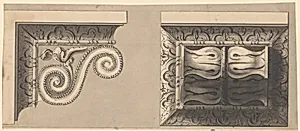
Medium
Pen and black ink, brush and gray wash, over graphite underdrawing
Dimensions
3 3/8 x 8 1/16 in. (8.6 x 20.4 cm)
Classification
Drawings
Department
Drawings and Prints
Museum
Metropolitan Museum of Art, New York, NY
Credit
Gift of William Rieder, 2009
Accession Number
2009.465.2
Rights
Public Domain
Tags
Art Historical Context
Richard de Lalonde's *Two Designs for Ornament*ca. 1770) captures the exquisite elegance of late 18th-century decorative arts. A prolific Parisian ornamentalist active during the Louis XV and early Louis XVI periods, Lalonde specialized in intricate motifs for furniture, silverwork, and interiors. These delicate drawings showcase paired ornamental schemes, likely intended as models for craftsmen, reflecting the era's shift from opulent Rococo curves toward more refined Neoclassical symmetry. Executed on a modest sheet measuring just 3⅜ × 8¹/₁₆ inches, the work employs a meticulous mixed-media technique: graphite underdrawing for initial planning, precise pen and black ink lines for definition, and subtle brush-applied gray wash for tonal modeling. This layered approach was standard for design drawings, allowing artists to convey texture and depth efficiently while serving as blueprints for luxurious objects. Housed in the Metropolitan Museum of Art's Drawings and Prints department (gift of William Rieder, 2009), these designs highlight the collaborative spirit of the decorative arts, where paper sketches bridged imagination and opulent reality. They offer a glimpse into the refined taste of pre-Revolutionary France, where ornament was both art and status symbol.