
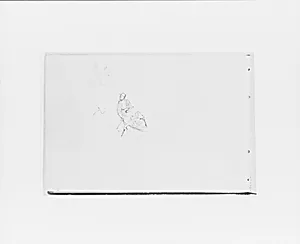
Two Figures (from Sketchbook X)
Medium
Graphite on off-white wove paper
Dimensions
5 x 7 1/2 in. (12.7 x 19.1 cm)
Classification
Drawing
Culture
American
Department
The American Wing
Museum
Metropolitan Museum of Art, New York, NY
Credit
Purchase, Gifts in memory of Stephen D. Rubin, 1992
Accession Number
1992.2.2m verso
Rights
Public Domain
Tags
Art Historical Context
William Trost Richards, a American artist of the late 19th century and associate of the Hudson River School, *Two Figures (from Sketch X)* in 1885. Known primarily for his meticulous landscapes inspired by John Ruskin's emphasis on natural detail, Richards filled numerous sketchbooks with preparatory studies like this one. Rendered during a period when American art was embracing realism and precision, this intimate drawing captures two human figures, offering a rare glimpse into the artist's exploration of form beyond his famed seascapes and nature scenes. Executed in graphite on off-white wove paper—a favored medium for its smooth texture and ability to hold fine lines and subtle tonal gradations—the work measures just 5 x 7½ inches, underscoring the portability and spontaneity of sketchbook practice. Richards's deft pencil work likely demonstrates his skill in anatomical observation, blending quick gesture with careful modeling to convey volume and movement. Now in the Metropolitan Museum of Art's American Wing, acquired through a 1992 purchase honoring Stephen D. Rubin, this piece highlights the everyday vitality of 19th-century American draughtsmanship. It invites visitors to appreciate how such modest sketches fueled grander compositions, bridging personal study with cultural narratives of human experience.
About the Artist
William Trost Richards · 1833–1905
William Trost Richards (1833–1905) was a prominent American landscape and marine painter born in Philadelphia, where he attended Central High School before beginning his artistic training. Between 1850 and 1855, he studied part-time under the German-born Hudson River School artist Paul Weber while working as a designer and illustrator of ornamental metalwork. He exhibited his first works at the Pe...