
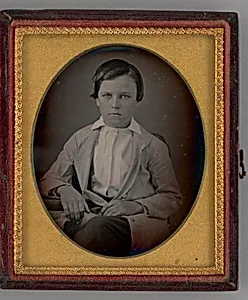
Untitled (Portrait of a Boy)
1850
Medium
Daguerreotype
Dimensions
8.2 × 7 cm (3 1/4 × 2 13/16 in.); Open case: 9.2 × 16 × 0.9 cm (3 5/8 × 6 5/16 × 3/8 in.); Case: 9.2 × 8 × 1.5 cm (3 5/8 × 3 3/16 × 5/8 in.); Plate: 8.3 × 7 cm (3 1/4 × 2 3/4 in.)
Classification
portrait
Department
Photography and Media
Museum
Art Institute of Chicago
Accession Number
250032
Rights
Public Domain
Art Historical Context
This poignant *Untitled (Portrait of a Boy, created around 1850 by an unknown maker, captures the dawn of photography through the daguerreotype process—one of the earliest and most revolutionary image-making techniques. Invented by Louis Daguerre 1839, daguerreotypes produced exquisitely detailed, one-of-a-kind positives on silvered copper plates, requiring long exposure times that demanded subjects remain perfectly still. Housed in a protective case measuring just 9.2 × 8 × 1.5 cm, this tiny portrait (plate: 8.3 × 7 cm) exemplifies the intimate scale of early photographs, often treasured as personal keepsakes. In mid-19th-century America and Europe, daguerreotypes democratized portraiture, making lifelike images accessible beyond elite painters. This boy's solemn gaze reflects the era's formal photographic conventions, where subjects posed with quiet dignity amid the novelty of being "captured" by light. As a prime example in the Art Institute of Chicago's Photography and Media department, it highlights photography's shift from novelty to cultural staple, preserving fleeting youth in mirror-like clarity before reproducible processes like tintypes emerged. Though the boy's identity remains a mystery, the work invites us to ponder everyday lives from 170 years ago, underscoring daguerreotype's enduring magic: unparalleled sharpness and a subtle, reflective sheen that draws viewers into history's gaze.