
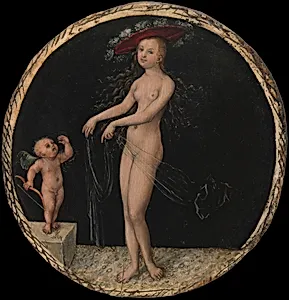
Venus and Cupid
ca. 1525–27
Medium
Oil on wood
Dimensions
Diameter 4 3/4 in. (12.1 cm)
Classification
Paintings
Department
European Paintings
Museum
Metropolitan Museum of Art, New York, NY
Credit
The Jack and Belle Linsky Collection, 1982
Accession Number
1982.60.48
Rights
Public Domain
Tags
Art Historical Context
Nestled in the Metropolitan Museum of Art's European Paintings department, *Venus and Cupid* by Lucas Cranach the Elder (ca. 1525–27) is a gem of intimate scale—just 4¾ inches in diameter. This circular oil-on-wood t captures the Roman goddess of love, Venus, in a graceful nude pose alongside her son, Cupid, evoking themes of beauty, desire, and affection. The petite format suggests it was crafted for private contemplation, perhaps as a treasured cabinet piece for a Renaissance collector. Cranach, a leading German Renaissance artist and court painter to the Electors of Saxony, was renowned for his elegant depictions of mythological nudes, blending Northern precision with Italianate grace. His oil technique yields a luminous, enamel-like finish on the wood panel, highlighting Venus's idealized form and Cupid's playful presence. This work exemplifies his prolific output of Venus subjects during the 1520s, a time when classical antiquity was revived amid the Protestant Reformation's cultural shifts. Part of The Jack and Belle Linsky Collection (1982), this painting underscores Cranach's influence in merging sensuality with moral symbolism—Venus often embodies both temptation and divine allure. Visitors are drawn to its exquisite detail, a window into 16th-century tastes for personal, provocative art.
About the Artist
Lucas Cranach the Elder · 1472–1553
Lucas Cranach the Elder (c. 1472-1553) was one of the most prominent German Renaissance painters and a key artistic figure of the Protestant Reformation. Born in Kronach, Franconia, to the painter Hans Maler, Cranach began his career in Vienna around 1502, where he became one of the founders of the Danube School, a movement characterized by expressive landscape painting and emotional force. His ea...