
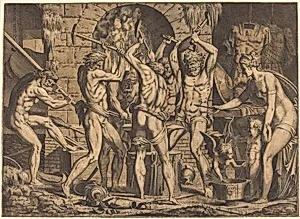
Venus at Vulcan's Forge
1401 to 1500
Medium
etching
Dimensions
sheet: 32.7 × 44.7 cm (12 7/8 × 17 5/8 in.)
Classification
Department
CG-E
Museum
National Gallery of Art, Washington, D.C.
Credit
Gift of David Keppel
Accession Number
1947.16.1
Rights
Public Domain
Art Historical Context
**Venus at Vulcan's Forge is a captivating etching by the French artist Léon Davent, dating to the late 15 century (circa 1401–1500). Measuring 32.7 × 44.7 cm, this print belongs to the Gallery of Art's collection (Department CG-E), generously gifted by David Keppel. As a classified print, it exemplifies the growing artistry of graphic media during the Renaissance transition, when mythological themes from classical antiquity were revived to celebrate human form and divine narratives. The title evokes a vivid scene from Roman mythology: Venus, goddess of love and beauty, visiting the forge of her husband Vulcan, the blacksmith god of fire and metalworking. Such subjects were popular in Renaissance art, blending pagan lore with emerging humanist ideals, allowing artists to explore dramatic contrasts of delicacy and industry. Davent's work captures this tension, likely drawing on the era's fascination with ancient stories as preserved in texts like Ovid's *Metamorphoses*. Etching, the medium here, marked a technical leap in printmaking around this period. Unlike rigid engravings, it used acid to etch fluid lines into a metal plate, enabling richer tones and expressive details ideal for intricate forge scenes and ethereal figures. This piece invites visitors to appreciate how prints democratized art, making grand myths accessible beyond paintings, and reflects the innovative spirit of late medieval to early Renaissance workshops. A true gem for print enthusiasts! (198 words)
About the Artist
Léon Davent · 1540–1556
**Léon Davent** (also known as Master L.D. or the monogrammist L.D.) was a French printmaker active in the mid-16th century, best known for his work in both engraving and etching. He played a leading role in the printmaking workshop associated with the First School of Fontainebleau at the Palace of Fontainebleau during the 1540s. His prints, often signed simply “L.D.,” reproduced designs by Italia...