
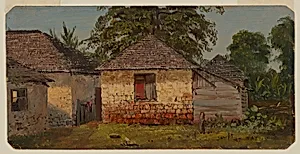
Village on Mt. Salus, Jamaica
Classification
landscapes
Department
Smithsonian Collection
Museum
Smithsonian American Art Museum
Credit
Gift of Louis P. Church
Accession Number
1917-4-681
Rights
Public Domain
About this artwork
Research in Progress
Art Historical Context
Frederic Edwin Church, a leading figure of the Hudson River School, captured the lush vistas of Jamaica in *Village on Mt. Salus, Jamaica*, painted in June 1865. This landscape reflects Church's passion for documenting the world's natural wonders during his travels through the West Indies that year, a period of personal exploration amid America's post-Civil War recovery. Mt. Salus, a hilltop vantage in Jamaica, likely offered Church sweeping views of verdant valleys and clustered villages, evoking the sublime beauty he so masterfully rendered in iconic works like *Niagara* and *Heart of the Andes*. Church's meticulous style—blending romantic grandeur with precise observation—influenced generations of American landscape painters. Though the medium remains unidentified, the work exemplifies his ability to infuse exotic locales with spiritual resonance, portraying nature as both majestic and intimately human-scaled through village life. As a snapshot from his Caribbean sojourn, it highlights 19th-century American artists' growing fascination with global destinations. Now in the Smithsonian American Art Museum's collection, gifted by Church's son Louis P. Church, this piece awaits further research, inviting visitors to ponder its role in the artist's oeuvre and the era's expanding worldview.