
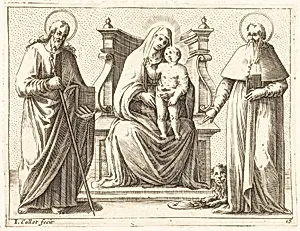
Virgin and Child with Saints James and Jerome
1608/1611
Medium
engraving on laid paper
Dimensions
plate: 9.5 × 12.2 cm (3 3/4 × 4 13/16 in.) sheet: 17 × 13.3 cm (6 11/16 × 5 1/4 in.)
Classification
Department
CG-E
Museum
National Gallery of Art, Washington, D.C.
Credit
R.L. Baumfeld Collection
Accession Number
1969.15.265
Rights
Public Domain
Art Historical Context
In the early 17th century, artist Jacques Callot createdVirgin and Child with Saints and Jerome* (ca 1608–161), a delicate engraving on paper measuring just 9.5 ×12.2 cm on plate. Callot, a pioneering printmaker of the era, honed his skills Florence under Giulio Parigi, intricate line work that brought religious devotion to life in format. This piece exemplifies his style, blending Mannerist elegance with emerging Baroque drama, as the Virgin tenderly holds the Christ Child flanked by the scholarly St. Jerome and pilgrim St. James—icons of piety during the Counter-Reformation. Engraving, Callot's chosen medium, involved meticulously incising lines into a copper plate, inking it, and pressing onto laid paper (notable for its textured chain lines). This technique allowed for exceptional detail and tonal depth in small-scale prints, making sacred imagery affordable and widespread for private devotion across Europe. Housed in the National Gallery of Art's CG-E department from the R.L. Baumfeld Collection, this work highlights printmaking's role in democratizing art amid religious fervor. Callot's precision foreshadowed his later masterpieces, like the *Miseries of War*, cementing his legacy as a virtuoso whose engravings captured both tenderness and turmoil. Visitors, imagine this intimate scene illuminating a collector's cabinet, whispering faith through every fine line.
About the Artist
Jacques Callot · 1592–1635
Jacques Callot (1592–1635) was a French printmaker and draftsman from the Duchy of Lorraine, widely regarded as one of the first great artists to practice the graphic arts exclusively. His more than 1,400 etchings chronicled the breadth of 17th-century life, from Medici court festivities to the brutal realities of warfare. Callot revolutionized etching through technical innovations including the é...